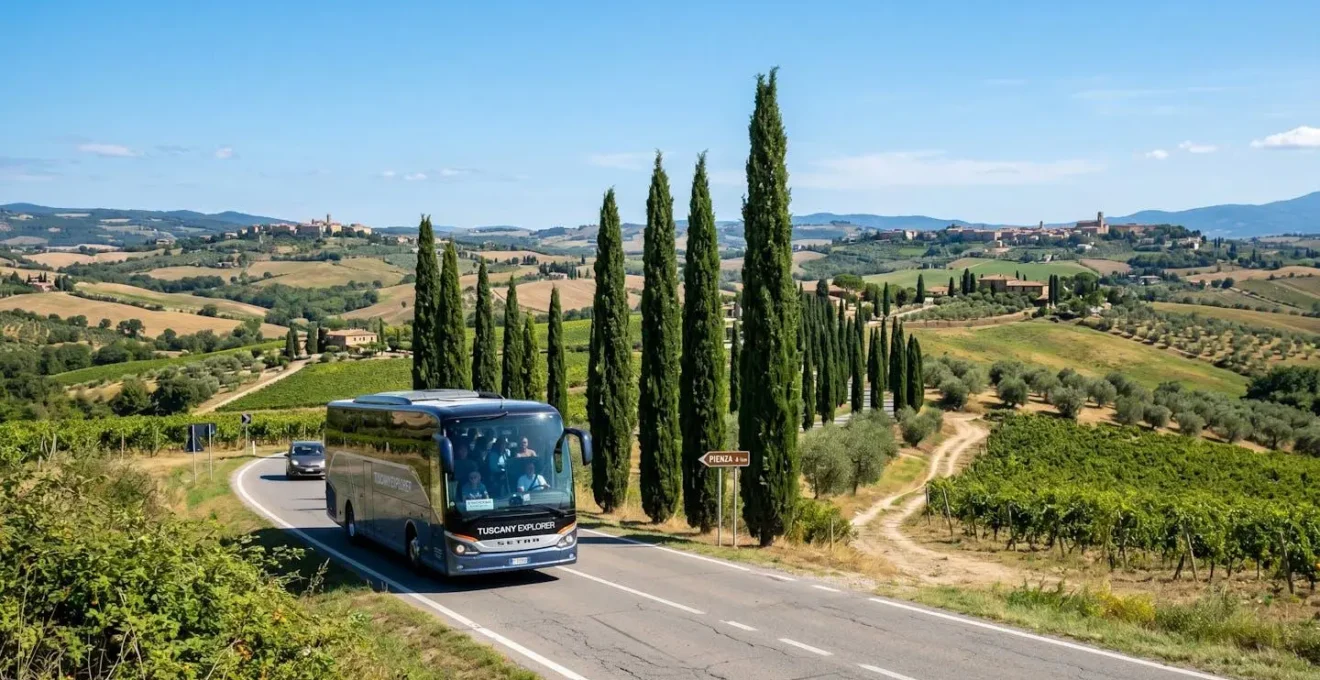
Planning a Tuscany trip from the US often means confronting an uncomfortable reality: rental cars come with ZTL zone fines and parking nightmares, while regional trains leave gaps in schedules to smaller hill towns like San Gimignano. According to IRPET‘s 2024 Tuscany tourism report, foreign visitors surged by 10.3% last year, with North American travelers up 7.4%—many discovering that navigating between Florence, Pisa, and Siena requires more strategy than anticipated.
Guided intercity bus tours address this logistics puzzle directly. Services like Tootbus connect major Tuscan cities with modern coaches equipped with multilingual audio commentary, eliminating the stress of Italian traffic laws while adding cultural context that silent train rides can’t provide.
This guide breaks down exactly how intercity bus tours work in Tuscany and which pass duration matches your itinerary.
Your Tuscany intercity bus essentials in 30 seconds:
- Two main routes connect Florence to Pisa-Lucca (Green Route) and San Gimignano-Siena (Terracotta Route)
- Multi-day passes (2, 3, or 5 days) include onboard multilingual audio guides and complementary walking tours
- Eliminates rental car risks—no ZTL fines, zero parking stress in historic centers
- Real-time bus tracking and AI assistance in 50+ languages via smartphone app
- Pass activates on first scan, not purchase date, giving booking flexibility
What guided intercity bus tours offer in Tuscany
Tuscany’s tourist appeal concentrates in a triangle roughly 50 miles per side: Florence anchors the north, Siena holds the south, and Pisa marks the west. The challenge isn’t mileage; it’s navigating medieval city centers designed for horses, not rental cars, while simultaneously absorbing enough Renaissance history to justify the transatlantic flight.
Intercity bus tours reorganize this equation. Instead of plotting Google Maps routes around Zona Traffico Limitato restrictions, you board a scheduled coach at a central Florence departure point. The route follows highways connecting the region’s UNESCO World Heritage sites while onboard audio commentary—synchronized to GPS location—delivers historical context timed to exactly when you pass relevant landmarks. As the Centro Studi Turistici 2025 figures for Tuscany confirm, visitor satisfaction with guided transport options in Tuscany reached a five-year high, reflecting growing preference for curated experiences over independent navigation.
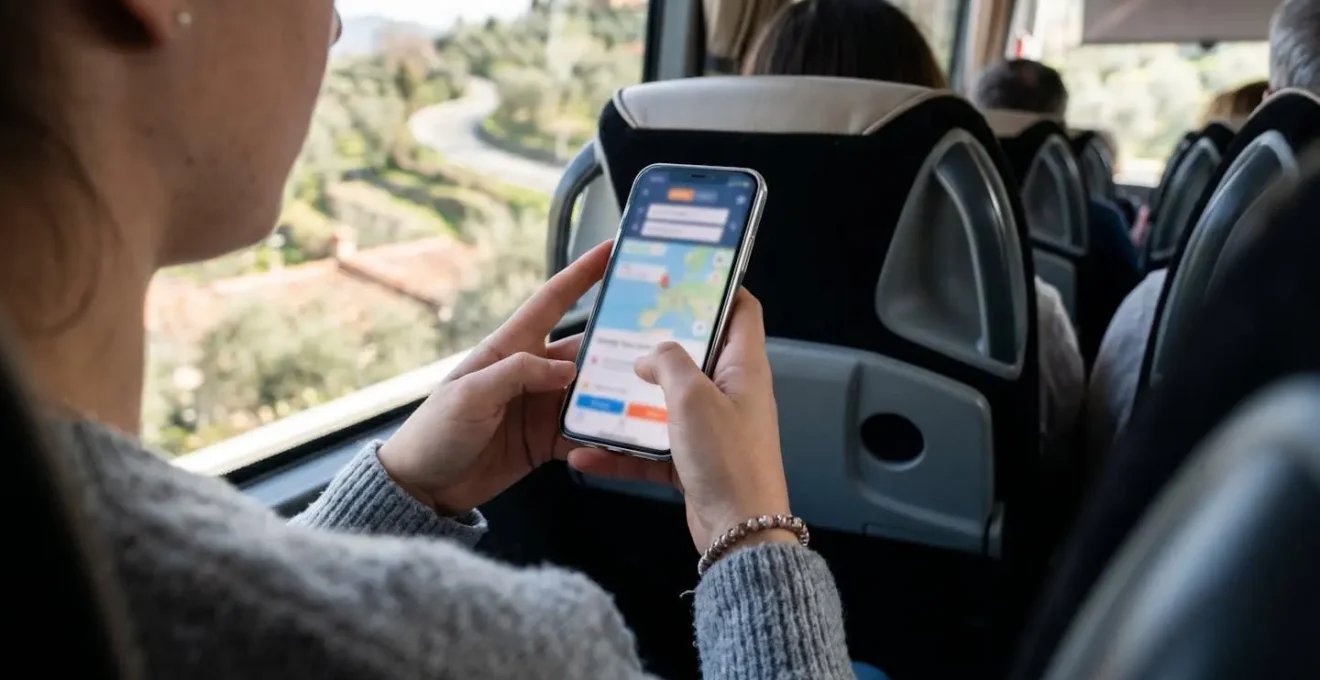
The typical service structure includes multi-day passes valid across designated routes. Purchase a three-day pass and you can board any scheduled departure on your chosen route during that validity window—morning bus to Pisa for the Leaning Tower, afternoon return to Florence, next day’s departure to Siena. The pass activates when you first scan it onboard, not at purchase, which matters for travelers booking in advance but keeping itinerary flexibility. What distinguishes this from simply buying point-to-point train tickets is the integration of commentary—buses explain why Galileo’s experiments at the cathedral matter to physics history while you’re still 10 minutes outside Pisa.
How bus tours compare to rental cars and trains in Tuscany
The practical question facing most US travelers is straightforward: which transport method actually works in Tuscany without consuming vacation time in logistical frustration? Here’s the breakdown across five decision factors that matter in real-world use.
| Criteria | Guided Bus Tours | Rental Car | Regional Trains |
|---|---|---|---|
| Budget Impact | Moderate (multi-day pass with unlimited route travel) | High (rental + fuel + parking fees + ZTL fines €100-150/incident per Florence municipal data) | Low to moderate (per-route tickets, multiple purchases needed) |
| Navigation stress level | Minimal (predetermined routes, no driving responsibility) | Elevated (ZTL camera enforcement, Italian traffic norms, parking scarcity in historic centers) | Moderate (schedule coordination, limited service to hill towns requiring bus transfers) |
| Cultural enrichment | High (synchronized audio commentary plus optional walking tours at destinations) | Zero (self-guided with no structured narrative) | Zero (transport function only) |
| Schedule flexibility | Medium (fixed route departures, flexible within pass validity period) | Maximum (go anywhere, anytime within rental period) | Low (rigid timetables, advance booking recommended for peak travel) |
| Language barriers | None (multilingual audio and AI assistance) | Significant (road signs, parking machines, ZTL regulations in Italian) | Moderate (ticket machines, platform announcements, station navigation) |
These trade-offs crystallize when planning specific itineraries. A three-day Florence-based trip illustrates the decision: rental cars offer flexibility to add spontaneous vineyard stops but require navigating ZTL cameras and deciphering parking signs in Italian. Trains deliver budget efficiency but force you to skip San Gimignano entirely or accept a complex Poggibonsi transfer. Guided buses eliminate navigation stress while adding cultural narration—the middle path that most first-time US visitors find matches their priorities.
Italian historic centers protect their medieval infrastructure through Zona Traffico Limitato enforcement—camera-monitored restricted zones that photograph license plates and mail fines to rental agencies weeks after you’ve returned home. Florence’s ZTL covers most of the tourist center you actually want to visit, with fines averaging around 100 euros per violation. Even outside ZTL boundaries, parking operates on a scarcity model—Siena’s historic core sits atop a hill with parking confined to perimeter lots requiring 15-minute uphill walks.
Trenitalia operates frequent service on the Florence-Pisa corridor, but problems emerge when your itinerary includes smaller destinations. San Gimignano, the iconic medieval hill town, has no train station—the workaround requires taking a train to Poggibonsi, then catching a local bus for the final segment, a connection that doesn’t always align smoothly and requires navigating Italian bus schedules without English-language support.
The intercity bus model trades maximum spontaneity for operational simplicity and added educational value. You surrender the ability to detour to an undiscovered trattoria spotted from the highway, but you gain freedom from parking anxiety and simultaneous access to expert narration explaining why Siena’s Palio horse race matters to urban identity.
- Zero driving responsibility or parking logistics
- Cultural commentary synchronized to locations
- Reaches San Gimignano without train-bus transfers
- Multilingual support eliminates language barriers
- Fixed departure schedules reduce spontaneity
- Cannot deviate to unplanned villages or vineyards
- Requires coordination with bus timetables for each city visit
Tootbus Tuscany intercity routes and onboard experience
Tootbus Tuscany operates two primary routes designed to connect the region’s UNESCO sites and medieval centers without requiring travelers to navigate Italian traffic regulations. The Green Route links Florence, Pisa, and Lucca in a northern Tuscany circuit, delivering you to Pisa for the iconic Leaning Tower complex, then continuing to Lucca’s intact Renaissance walls. The Terracotta Route covers southern destinations: Florence to San Gimignano’s medieval tower skyline, then onward to Siena’s shell-shaped Piazza del Campo. Both routes operate from modern coaches equipped with WiFi, wheelchair accessibility, and panoramic windows optimized for Tuscan landscape viewing.
Onboard, GPS-synchronized audio commentary available in multiple languages cues historical context as the bus approaches landmarks—when Pisa’s Piazza dei Miracoli comes into view, the audio guide explains why Galileo’s pendulum experiments in the adjacent cathedral mattered to physics, integrating narration with visual observation in real time.
How Tootwalk extends your exploration: After arriving in Siena via Tootbus, launch the Tootwalk feature within the app to access audio-guided walking routes through the Contrade neighborhoods—those distinct districts that compete in the famous Palio horse race. A 45-minute narrated stroll explains the banners, fountains, and territorial pride that define Sienese identity. No separate booking required; walking tour content syncs automatically with your bus pass for seamless city-level exploration once you disembark.
The Tootbus app adds operational support beyond audio content. Real-time GPS tracking shows exactly where buses are on the route, letting you time your arrival at departure points instead of anxiously waiting. Tootie, the integrated AI assistant, responds to questions in over 50 languages—ask “What time does the next bus leave for Lucca?” or “Which restaurants near Piazza del Campo are open now?” and receive immediate answers without language translation hassles. Passes activate upon first scan aboard the bus, not at purchase, eliminating pressure to use them immediately and providing framework for self-directed exploration.
Choosing the right pass for your itinerary
American travelers consistently overestimate how much they can accomplish per day in Tuscany. The 50-mile Florence-Siena-Pisa triangle looks compact on Google Maps, but medieval city centers require walking time—you can’t just “hop out for 20 minutes.” Understanding realistic time allocation per destination determines which pass duration actually serves your itinerary rather than expiring with unused days.
Consider Sarah, a 52-year-old teacher from Portland planning her first Tuscany trip. With seven days total and anxiety about Italian driving, she chose a 3-day bus pass to cover Pisa, Siena, and Lucca while basing in Florence—eliminating rental car stress while accessing cultural commentary she’d miss on trains. This decision pattern repeats across first-time US visitors prioritizing enrichment over maximum spontaneity.
Pass selection comes down to honest accounting: how many days are you allocating to intercity exploration beyond Florence itself, and which specific destinations rank as non-negotiable on your bucket list? The three standard durations—2-day, 3-day, and 5-day—correspond to distinct travel patterns.
- If you have 2 days for intercity travel beyond Florence:
Choose the 2-day pass and focus on one complete route. Either tackle the Green Route (Florence-Pisa-Lucca) for northern Tuscany’s architectural highlights, or the Terracotta Route (Florence-San Gimignano-Siena) for medieval hill town atmosphere. Attempting both routes in 48 hours leaves you rushed and prevents meaningful Tootwalk exploration at each city.
- If you have 3-4 days available:
The 3-day pass provides breathing room to complete one full route with extended stays. Spend a full day in Siena (morning Duomo visit, afternoon Palio museum, evening passeggiata in Il Campo), return to Florence overnight, then dedicate day two to Pisa and day three to Lucca. This pace allows Tootwalk usage without feeling like you’re racing through a checklist.
- If you have 5+ days dedicated to regional exploration:
The 5-day pass justifies tackling both routes for comprehensive coverage. You can allocate full days to major destinations (Siena, Lucca) while treating Pisa and San Gimignano as half-day visits, building in flexibility for weather-dependent plans or spontaneous extended stays when a city exceeds expectations.
The shortest pass duration suits travelers with limited regional time or those primarily focused on Florence who want one or two landmark day trips—dedicate day one to Pisa, then use day two for either Lucca’s wall walk or a San Gimignano medieval tower climb. Three days represents the sweet spot for first-time visitors who want meaningful engagement with Tuscany beyond Florence, typically allocating one full day to Siena, one day to the Pisa-Lucca combination, and a third day held in reserve. The extended five-day pass makes sense for travelers treating Tuscany as the primary destination. Italy’s 2024 inbound tourism figures compiled from UNWTO data show American visitors increasingly favor deeper regional exploration over rapid multi-city touring, with average stays extending to support more thorough destination engagement.
- Download the bus service app before leaving the US—cellular data in Italy costs more than pre-loading offline maps
- Charge your smartphone fully and bring a portable battery—audio guides drain power faster than casual phone use
- Identify two or three priority Tootwalk routes in your target cities—knowing which walking tours you want prevents decision paralysis upon arrival
- Verify bus departure times via the app schedule feature—frequency varies by season and day of week
- Pack layers regardless of season—Tuscan microclimates mean Siena’s hilltop can be 10 degrees cooler than Florence’s river valley
Your questions about Tuscany bus tours
Do I need advance reservations for each bus, or can I just show up?
Once you’ve purchased your multi-day pass, no individual bus reservations are required. Simply arrive at the designated departure point and scan your pass when boarding any scheduled service on your selected route. The pass functions as an unlimited-use ticket during its validity period.
What if I don’t speak Italian—will I struggle with the service?
Audio commentary is available in English along with multiple other languages, and AI assistant features respond to questions in over 50 languages via the smartphone app. Language barriers that complicate train travel or car rental essentially disappear with guided bus services that specifically accommodate international visitors.
Are the buses accessible for travelers with mobility limitations?
Yes, modern intercity tour coaches include wheelchair accessibility features and designated spaces for travelers with reduced mobility. This eliminates a significant challenge that complicates navigating medieval Tuscan cities independently, where historic centers feature cobblestones and limited elevator access.
Can I get off in one city and catch a later bus, or am I locked into specific departures?
The multi-day pass provides exactly this flexibility. Disembark in Siena at 10am, spend six hours exploring, then board the 4pm return to Florence—or stay overnight and catch tomorrow’s bus instead. As long as you’re within your pass validity window, you control the pacing.
Is WiFi actually functional onboard, or is it nominal coverage that doesn’t work?
Buses provide free WiFi designed to support app usage for real-time tracking, accessing walking tour content, and communicating with the AI assistant during transit. Connection quality suffices for these functions, though streaming video remains impractical given bandwidth limitations with multiple passengers online simultaneously.
What happens if I buy the wrong pass duration and want to extend?
Pass modification policies vary by provider, but the activation-on-first-scan system means you’re not locked into immediate use upon purchase. If you realize during day two of a 3-day pass that you need more time, contact customer service via the app before your current pass expires—many operators can upgrade to longer durations by charging the difference rather than requiring full new pass purchase.
Here’s what actually moves you forward: pull up the departure schedule for your preferred routes, cross-reference with your planned Florence accommodation location, and verify the nearest pickup point. Download the service app tonight while you’re still on reliable WiFi. Identify which Tuscan destinations are genuinely non-negotiable for you and calculate whether 2, 3, or 5 days of intercity access matches that priority list. If Tootbus’s structured routes covering Florence, Pisa, Siena, Lucca, and San Gimignano hit your target destinations, the operational simplicity and integrated cultural commentary deliver exactly what first-time visitors need to maximize limited vacation time without rental car stress.